Play Checkers Online
Classic 8×8 American Checkers — jump, capture, and king your pieces
- Multiplayer
- No sign-up
- 100% free
Checkers online lets you play the classic board game in your browser — free, with no signup — against the computer, a friend, or a random opponent, across twelve rule variants.
How to Play American Checkers
American Checkers (English Draughts) is the version most people grew up with: two players, twelve pieces each, one 8×8 board. All movement happens on the dark squares — the 32 light squares are decorative. Each player starts with pieces filling the three rows nearest their side, and pieces move diagonally, one square forward at a time.
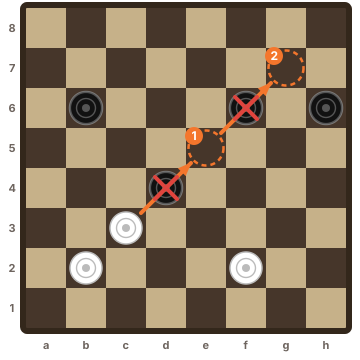
The force-jump rule applies whenever a capture is available: if an opponent's piece sits diagonally ahead with an empty square beyond it, you must jump and take it — you can't choose a different move instead. If two captures are available, you pick which one. Chains work in a single turn: after a jump, if another capture opens from the landing square, you continue with the same piece. A well-placed piece can clear three or four opponents in one move.
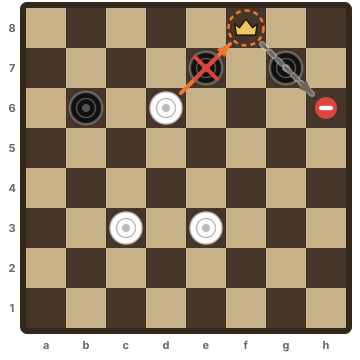
When your piece reaches the opponent's back row, it becomes a King, marked with a crown. Kings move and capture in any diagonal direction, forward and backward. One thing trips people up: if your piece jumps to the back row while capturing, the turn ends there — it doesn't continue jumping backward in the same move.
Rules at a glance
- Move diagonally forward on dark squares
- Capturing is mandatory — you must jump when a capture is available
- Multi-jump captures in a single turn are required when possible
- Reach the far row to promote a piece to King
- Kings move diagonally in any direction
Winning
The game ends when one player captures all opponent pieces, or leaves them with no legal move. A game is drawn by threefold repetition, or when no capture or man move has occurred for 40 moves by each side — the same draw law used in tournament play. Full detail is on the American Checkers rules page.
Play the computer at three difficulty levels — easy, medium, or hard — or take on a real opponent: hit Play Online to be paired with another player, create a private game and share the link or code with a friend, or sit two players at one device. No account needed.
Twelve Variants, Twelve Different Games
Most checkers sites give you one set of rules. This one plays twelve, and the differences between them aren't cosmetic.
| Variant | Board | Pieces each | Kings | Capture rule |
|---|---|---|---|---|
| American Checkers | 8×8 | 12 | Short (one square) | Take any capture |
| Pool Checkers | 8×8 | 12 | Flying (any distance) | Take any capture |
| Brazilian Draughts | 8×8 | 12 | Flying (any distance) | Take the most pieces |
| Russian Checkers | 8×8 | 12 | Flying (any distance) | Take any capture |
| Czech Checkers | 8×8 | 12 | Flying (any distance) | Take any, kings before men |
| Spanish Checkers | 8×8 | 12 | Flying (any distance) | Most pieces, kings break ties |
| Portuguese Checkers | 8×8 | 12 | Flying (any distance) | Most pieces, kings break ties |
| Filipino Checkers | 8×8 | 12 | Flying (any distance) | Take the most pieces |
| Moroccan Checkers | 8×8 | 12 | Flying (any distance) | Take the most pieces |
| International Draughts | 10×10 | 20 | Flying (any distance) | Take the most pieces |
| Canadian Checkers | 12×12 | 30 | Flying (any distance) | Take the most pieces |
| Chinese Checkers | 121-hole star | 10 | No kings | No captures — race home |
American Checkers, called English Draughts in the UK, is the classic above: an 8×8 board, 12 pieces per side, and short kings that move one square at a time. It's also a solved game — in 2007, Jonathan Schaeffer's team at the University of Alberta completed a computational proof with their program Chinook: two players making no mistakes will always draw. That doesn't make it easy to beat a real opponent; it just means there's a known perfect answer to every position.
Brazilian Draughts uses the same 8×8 board and 12-piece setup but replaces short kings with flying kings. A king in Brazilian slides any number of squares along a diagonal, like a bishop in chess. That single rule rewrites the endgame: a lone king can threaten from across the board, and chases become long, precise sequences instead of a slow corner retreat. If American Checkers endgames feel too settled too quickly, Brazilian fixes that.
International Draughts is the competitive standard worldwide, governed by the FMJD (World Draughts Federation, founded 1947). It plays on a 10×10 board with 20 pieces per player and flying kings. The larger board means longer games, more complex openings, and captures that can cross the entire board in one turn. If you've ever wondered why some players treat checkers as seriously as chess, they're playing International Draughts.
Canadian Checkers goes bigger still: a 12×12 board, 30 pieces per side, following International rules. Games run long — rare outside serious competitive circles, but it exists, and you can play it here.
That's four of the twelve. Pool, Spanish, Russian, Czech, Portuguese, Filipino, Moroccan, and Chinese Checkers each change the game again — see how they all compare in the checkers variants guide, or head to the online lobby to play any of them against a real opponent.
A Short History
The game is old. Checkers-like boards and pieces turn up in ancient Egyptian archaeology — the British Museum displays boards found in burial chambers — and Alquerque, a 5×5 game whose rules already look like checkers, was played in Egypt around 1400 BC. Around 1100, a French player moved the game onto the 8×8 chessboard and raised the piece count to twelve; English Draughts codified the modern rules in the 17th century, and the game crossed the Atlantic with settlers, where the name shifted to checkers.
For most of its history the game seemed inexhaustibly deep. Then came Schaeffer's 2007 proof, which settled that: checkers joined the short list of games with a known optimal outcome — though the road to a perfect draw involves real calculation. The FMJD continues to govern international competition, and International Draughts remains a serious discipline with national teams and world championship events. The full story is in our posts on the origins of draughts and the history of checkers.
Beginner Strategy
Capturing pieces feels like the goal. It isn't — position is. A few habits separate players who win close games from players who don't:
- Control the center. The most common mistake is chasing captures at the expense of board control. Pieces in the center can attack in more directions than pieces stuck on the edges; edge pieces are safer (they can only be jumped from one side) but passive. Active pieces win games.
- Promote a King only when it's cheap. Getting a king early feels great, but not if it costs two regular pieces to do it. A king is twice as mobile, but you're trading two for one — promote when the opportunity cost is low.
- Watch for the sacrifice trap. Your opponent offers a piece you're forced to take, then jumps two of yours from behind. If a capture looks free, ask what comes after.
- Hold your back row. Keep at least one piece on your back row for as long as you can. It blocks your opponent from promoting and costs nothing to maintain.
Want to go further? Read our Checkers strategy guide, or browse every strategy lesson — common openings, endgame patterns, and the forced-win sequences that decide most close games.
Up for a quick challenge? Try today's Checkers Daily puzzle — a new winning position to solve against the AI every day.
Frequently Asked Questions
Is checkers online free?
Yes. Every game here plays free in your browser, with no download and no sign-up. You can play the computer, a friend, or a random opponent at no cost.
Do I need an account to play?
No. You can play the AI, two players on one device, or an online match against another player without signing up. An optional free account tracks your rating and stats across variants.
Can I play checkers online against another person?
Yes. Hit Play Online to be matched with a random opponent, or create a private game and share the link or code with a friend. There is also a two-player hot-seat mode on a single device.
Can I play checkers against the computer?
Yes. The AI plays at three difficulty levels — easy, medium, and hard — so you can practise or push yourself.
What is the difference between checkers and draughts?
They are the same family of game. "Checkers" is the American name and "draughts" is used in the UK and much of the world. American Checkers is English Draughts; International Draughts is the 10×10 competitive version.
Is checkers a solved game?
American Checkers is solved: in 2007 Jonathan Schaeffer's Chinook project proved that with perfect play by both sides the game is always a draw. Beating a strong human opponent is still hard.