Chinese Checkers Strategy: How to Win the Race
How do you win at Chinese Checkers? You get all 10 of your marbles into the point of the star opposite your start before your opponent does. Nothing is ever captured, so the game is a pure race. The player who wastes fewer moves wins. Every tip below comes back to that one idea: find moves that cover more ground than your opponent’s, and avoid the moves that cost you turns later. This guide is written for the two-player game you can play here, with a short note at the end on games with more players.
It’s a race, so count moves
Think of each turn as a unit of time. Chess players call this tempo; here it means the number of moves you are ahead or behind in the race.
You can measure the race on this board. Add up how many rows your 10 marbles have to travel to fill the goal triangle, and the total is 120 rows. A step moves a marble one hole, so it gains at most one row. Each hop in a chain gains up to two rows. A player who only stepped would need at least 120 turns. A chain of four hops straight up the board gains eight rows in one turn, which is seven turns saved over stepping.
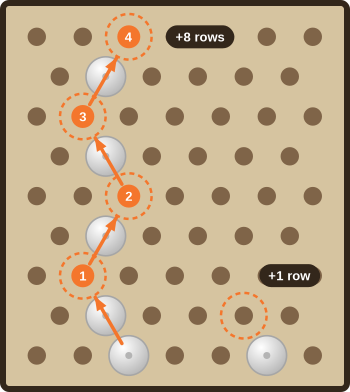
So before each move, ask two questions. How far forward does this move take me? And what does it set up for my next move? A short step that opens a long chain next turn can be worth more than a medium hop now.
Moves that go sideways or backward cost tempo. Make them only when they pay you back, for example by setting up a chain you could not reach otherwise.
Openings: get a route started
The first few moves decide how fast your army gets moving. In the starting position your marbles are packed tight with no gaps to hop into, so the opening is about making room. You have 14 legal first moves: 8 single steps and 6 hops.
Two openings have names. A Wikibooks strategy guide calls the “sidewinder” and the “cross caterpillar” the two most common, and says both start by moving one of the two marbles at either end of your front row. A LoveToKnow guide tells them apart by direction:
- Sidewinder: the end marble moves diagonally outward, toward the edge of the board.
- Cross caterpillar: the same marble moves diagonally inward, toward the center line.
Wikibooks describes the two lines a little differently, so treat the directions as one guide’s labels.
Either way, the point is the same. A marble moved out of the front row leaves a hole behind it, and the marbles behind can now hop through. Your next few moves should use those openings to hop marbles out of the back of your triangle rather than walking the front marbles forward one hole at a time.
Build ladders and a central highway
A ladder is a line of marbles with an empty hole between each one, so another marble can hop up it in a single chain. Ladders are how you save tempo. One good ladder can carry several marbles across the board, one per turn.
Build your ladders through the middle of the board. The center is the shortest path between the two points. Marbles near the middle can also serve as stepping stones for several turns, while a marble on the edge helps only the few marbles that pass right beside it.
Keep the landing holes open. Every hop needs an empty hole on the far side, so filling every gap in your formation kills your own chains. A spaced-out line of marbles is a ladder. A solid clump is a wall you have to walk around.
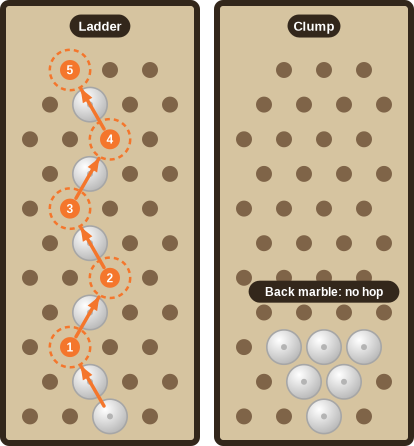
When your ladder has done its job, the marble at the back of it hops up to the front. Then the next one does. The ladder moves forward without ever breaking.
Move as a group, no stragglers
It is tempting to race your best-placed marble far ahead. Resist it. A lone runner has no marbles near it to hop over, so it slows to one hole a turn. Meanwhile the marbles it left behind have lost a stepping stone.
The bigger danger is at the back. A marble left in your start triangle has the longest trip of all. By the time it sets off, most marbles have left the middle of the board, so there may be nothing for it to hop over and it has to walk most of the way. Those lost turns can decide the game.
Our AI plays with this in mind. Its scoring counts how far every marble still has to travel, and it also subtracts points for the one marble furthest behind. You can do the same in your head: before a long hop with a front marble, check whether a back marble needs the move more.
Use the opponent’s marbles as stepping stones
You can hop over any marble, yours or your opponent’s, and the rules let you chain those hops in any direction. In the two-player game the armies pass through each other in the middle of the board. That crossing is the best ladder material in the game, because you didn’t have to spend moves building it.
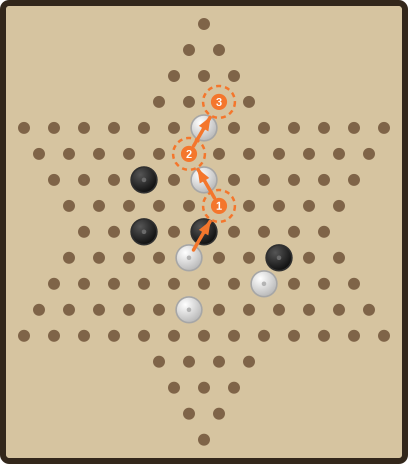
Watch for chains that use both colors. An opponent’s marble sitting in the center can be the first rung of a long chain made of your own marbles. It works both ways, since every marble you place is also a stepping stone for your opponent. Before you finish a move, look at where it leaves your marble and ask whether it hands your opponent a chain. The same goes for ladders. If you finish one and your opponent moves next, they may get to use it first.
Blocking in the two-player game
With only two players, every move that slows your opponent helps you as much as a move that speeds you up. That makes blocking a real option. You can park a marble on the landing hole of their best chain, or avoid stepping into the gap that would complete their ladder.
Blocking has a cost. A marble that sits still to block is not racing. If the block saves you more turns than it costs, it is good. If it costs you a turn and your opponent finds another path next move, you have lost tempo for nothing. Count both sides before you block.
The worst kind of block is one that gets in your own way. A marble parked in the center to stop your opponent may also sit on the hole your own back marbles needed.
The endgame: fill the goal from the back
The goal triangle has 10 holes, from the far tip down to the front row of four. Fill the deepest holes first. If you fill the front holes early, your later marbles have to squeeze past them, and the front marbles can block the hops they need to get deep. Sources differ a little here. The LoveToKnow guide suggests working in from the sides. Both ideas agree on the main point: don’t seal the entrance before the back is full.
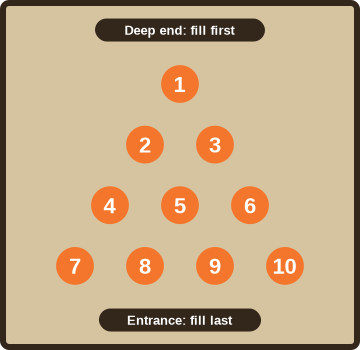
In the two-player game your goal is your opponent’s start triangle. At the start it is full of their marbles, and you cannot move in until they move out. So in the middle of the game, don’t rush marbles to the edge of the goal and wait. Keep them useful as ladder rungs until holes open up.
Near the end, plan the last few moves as a sequence. Count how many turns each remaining marble needs. Sometimes shuffling a marble already in the goal one hole deeper opens a hop for the last marble outside it and saves a turn.
Our house rule on goal camping
The classic rules have a loophole. A player can leave one marble in their own start triangle forever, and since that triangle is your goal, you can never fill it.
On this site that doesn’t work. You win as soon as every hole in your goal triangle is occupied and at least one of those marbles is yours, even if some belong to your opponent. A camping marble counts as filled, so the player who camps loses once you fill the holes around it. The rules page explains the rule in full.
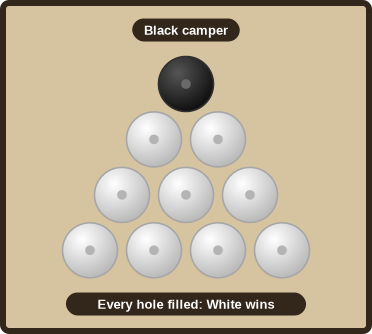
Two practical effects. First, don’t try to camp: it only slows your own race. Second, an opponent’s marble left in your goal does part of your job for you. Fill the holes around it and the win is yours.
With three or more players
Most of this advice carries over to bigger games, but the balance shifts. With more armies on the board, the center gets crowded and more people use the same ladders. Blocking one opponent no longer helps you as much, because the others gain from it too. In crowded games, favour moves that open fewer chains for your rivals. Our board is two-player only, so you can practice all of this against one opponent at a time.
Practice against the AI and check positions
The fastest way to learn tempo is to play. Start a game against the AI on easy or medium and watch how it builds chains. Then try hard. Beginner looks only at its own next move and picks the one that best advances its race. Each level above it looks further ahead at both players’ moves. Use the hint button when you are stuck, and undo a move to see what a different choice would have done.
To study one position, set it up in the Chinese Checkers solver. It uses the same engine as the AI and shows the best move it finds in about four seconds of searching. That is the best move the search found, not a proven best, but it is enough to test whether a block or a long hop is the better idea. And if you are curious why a German race game ended up named after China, read our post on the name. For the checkers family’s own strategy guides, see the lessons hub.