The Oldest Board Games in the World, and the Ancient Ones You Can Still Play
The oldest board games we know of come from Egypt and Mesopotamia and are up to about 5,000 years old. Senet, Mehen and the Royal Game of Ur lead the list. Senet and Mehen died out in ancient times, and Ur survived in only one community into the 1950s, so the rules people use today for Senet and Ur are modern reconstructions. The oldest game still played without a break is usually said to be Go, from China, at more than 2,500 years.
That split is the useful way to think about ancient board games. Some are old and lost, and we play them from educated guesses. Others are old and still in living use. Checkers, the game this site is built around, sits in the second group, though it’s one of the younger games here.
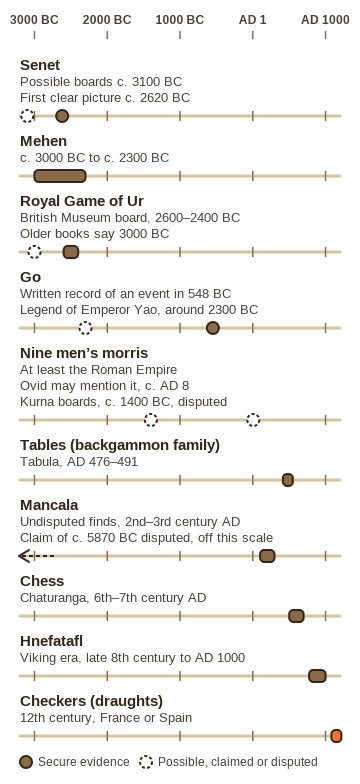
The oldest board games at a glance
| Game | Earliest evidence | Where | Played today? |
|---|---|---|---|
| Senet | Possible boards c. 3100 BC; first clear picture c. 2620 BC | Egypt | Yes, with reconstructed rules |
| Mehen | c. 3000 BC to c. 2300 BC | Egypt | No |
| Royal Game of Ur | British Museum board, 2600–2400 BC | Mesopotamia (Iraq) | Yes, with reconstructed rules |
| Go | Written reference to an event of 548 BC | China | Yes, believed unbroken |
| Nine men’s morris | At least the Roman Empire | Roman world, then Europe | Yes |
| Tables (backgammon family) | Ancestors at least 1,600 years back; Tabula AD 476–491 | Roman and Byzantine world, Persia | Yes, as backgammon and nard |
| Mancala | Undisputed finds from the 2nd–3rd centuries AD | Middle East, Africa | Yes |
| Chess | Chaturanga, 6th–7th century AD | India | Yes |
| Hnefatafl | Viking era, late 8th century to AD 1000 | Northern Europe | Yes, with reconstructed rules |
| Checkers (draughts) | 12th century | France or Spain | Yes |
Dates for games this old are often argued over. Where sources disagree, we give the range and say who claims what.
Senet: the oldest board game we can name
Senet was an Egyptian board game played on 30 squares in three rows of ten. Fragmentary boards that could be Senet turn up in First Dynasty burials from around 3100 BC. The first picture of the game that nobody disputes is in the tomb of the official Hesy-Re, dated to about 2620 BC. Some historians think Senet started in the Levant and reached Egypt from there.
Senet lasted a very long time. By the New Kingdom it had picked up religious meaning: Chapter 17 of the Book of the Dead shows the dead person playing against an unseen opponent. Then it fell out of use in the Roman period, and the rules went with it.
What people play today comes from the 20th century. When Senet boards turned up in excavations in the 1930s, the Swiss archaeologist Gustave Jéquier worked out a guessed set of rules from the boards and paintings. R. C. Bell and Timothy Kendall later wrote their own versions, and sellers of modern Senet sets have adopted them. In Kendall’s rules you throw four flat sticks as dice and race your pawns off the board. It’s a playable game. Whether an Egyptian would recognize it is another question.
Egypt had another game about as old. Mehen, named after a snake god, is found from about 3000 BC to the end of the Old Kingdom, around 2300 BC. After that it disappears from Egypt.
The Royal Game of Ur
The Royal Game of Ur is a two-player race game from ancient Mesopotamia, first played in the early third millennium BC. The British Museum holds one of the boards the archaeologist Leonard Woolley dug out of the Royal Cemetery at Ur in what is now Iraq. The museum dates it to 2600–2400 BC. It has 20 squares inlaid with shell, some marked with rosettes. Some older books say 3000 BC. Most recent sources, the British Museum included, use the later date.
This game traveled. Boards have been found from Crete to Sri Lanka, and four similar boards were buried with Tutankhamun, many with a Senet board on the back so the box could be flipped over. It also lasted far longer than you’d expect. The Jewish community of Kochi in India still played a version called Asha until the 1950s, when its members began emigrating to Israel.
Ur has something Senet lacks: part of a written rulebook. A Babylonian clay tablet written by a scribe named Itti-Marduk-balāṭu describes part of the game as it was played in the second century BC. From that tablet and the shape of the board, the British Museum curator Irving Finkel reconstructed the basic rules: race your pieces around the course and bear them all off before your opponent does. Like backgammon, it mixes luck and judgment. One theory says it evolved into the tables games that became backgammon. Another says those games simply pushed it aside.
What was the first board game?
Nobody knows. The oldest candidates are Senet and Mehen from Egypt, both traced to around 3000 BC. Possible Senet fragments go back to about 3100 BC, and the first clear picture is from about 2620 BC.
Another claim comes from Iran. Wikipedia’s backgammon article describes a game set from the Jiroft culture in Iran, nearly 5,000 years old, as the world’s oldest. Its rules are unknown, though it has been called the Game of 20 Squares, a game the Royal Game of Ur closely resembles.
What is the oldest board game still played today?
Go is the usual answer. It was invented in China more than 2,500 years ago, and Wikipedia’s article calls it “the oldest board game continuously played to the present day”, hedged as a belief. The earliest written reference is in the historical annal Zuo Zhuan, from about the 4th century BC, which describes an event of 548 BC. Confucius’s Analects mentions it too. A legend credits the mythical emperor Yao, around 2300 BC, but that’s a story, not evidence.
Two players place black and white stones on the points of a grid and try to fence off more territory than the other. The board started as 17×17 and had become 19×19 by the Tang dynasty (AD 618–907). A 2016 survey by the International Go Federation counted over 46 million people who know how to play and over 20 million current players, most of them in East Asia.
Nine men’s morris is another ancient game still widely played. Wikipedia dates it to at least the Roman Empire, and the poet Ovid may mention it around AD 8. Boards are carved into the cloister seats of English cathedrals such as Canterbury and Westminster Abbey. Some books push it back to 1400 BC on the strength of boards cut into roof slabs at Kurna in Egypt, but the scholar Friedrich Berger found Coptic crosses among those carvings and concluded: “Certainly they cannot be dated.”
Is mancala the oldest game in the world?
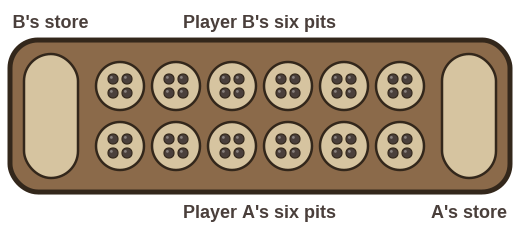
Mancala isn’t one game. It’s a family of “count and capture” games played with seeds or stones in rows of pits: you scoop up every seed in one pit and sow them one at a time into the pits that follow. The name comes from the Arabic root naqala, “to move”.
You’ll often read that mancala is the oldest game in the world. The evidence doesn’t back that up. Some experts point to pits in the floor of a Neolithic house at ‘Ain Ghazal in Jordan from about 5870 BC, but others dispute it. The finds nobody disputes are later: pottery boards and rock cuts in a Roman bathhouse at Gedera, from the 2nd and 3rd centuries AD, and boards from the Aksumite towns of Matara in Eritrea and Yeha in Ethiopia, from the 6th and 7th centuries AD. The oldest written mention is in the 10th-century Kitab al-Aghani, the “Book of Songs”.
So mancala is ancient, just not provably the oldest. It’s also very much alive. Oware, with two rows of six pits and 48 seeds, is played across Ghana and the Caribbean under names like ayò, awalé and wari. In the United States a version called Kalah was patented and sold in the 1950s. This history of mancala goes through the finds and the myths in more detail, and the same site lets you play Kalah in your browser against the computer or a friend, with no account.
Hnefatafl and the tafl games
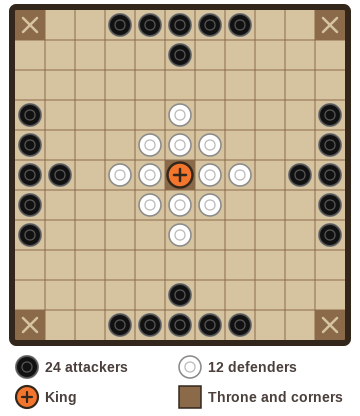
Tafl games are the board games of medieval Northern Europe, played in Scandinavia, Iceland, Britain, Ireland and Sápmi. They’re lopsided on purpose. One side has a king in the center and a small guard. The other side has about twice as many pieces. The king tries to escape and the bigger army tries to trap him. Wikipedia’s tafl article says the Roman game latrunculi influenced how they developed.
Hnefatafl, the Norse version, was popular in the Viking era, from the end of the 8th century to about AD 1000. Chess pushed tafl aside in the 12th century, and the Norse rules were never written down. Only pieces and broken boards survive.
The rules we have come by a strange route. In 1732 the Swedish naturalist Carl Linnaeus wrote down tablut, a tafl game the Sámi people were still playing. His Latin notes were translated into English in 1811, badly, and every modern tafl game is built on that translation, mistakes and all. Players have since patched the rules to balance the two sides. Copenhagen hnefatafl is one version used in tournaments today. If you want to try it, you can play hnefatafl against the computer at five levels, or with two players on one device, in six variants including Copenhagen, tablut and the Irish brandubh.
Chess: about 1,500 years old
Chess is traced back nearly 1,500 years to chaturanga in India. The earliest clear reference comes from north India in the sixth century AD, and the name itself first appears in a text from about AD 625. Most chess historians see chaturanga as the common ancestor of chess, the Chinese game xiangqi, Japanese shogi and Thai makruk.
From India the game passed to Persia, where it became shatranj, then through the Muslim world into Europe by way of Spain and Italy. It became the game we know late. The queen and bishop only got their long modern moves in Spain between about 1475 and 1500.
Checkers and its ancestors
Checkers, or draughts, is younger than most games on this list. It took shape in Europe in the Middle Ages, probably in France or Spain, around the 12th century. BoardGameGeek dates the European game to about 1150. The pieces moved onto the dark squares of the chessboard, and the first known book about the game was printed in Valencia in 1547.
The jumping capture is older than that board. It most likely came from alquerque, an Arabic game played on a grid of 5 by 5 points joined by lines, with 12 pieces a side. You capture in alquerque the way you do in checkers: jump an enemy piece into the empty point behind it, and keep jumping if you can. Alquerque is first mentioned in writing late in the 10th century, in the same Kitab al-Aghani that first mentions mancala. Its rules appear in the Libro de los juegos, the book of games commissioned by Alfonso X of Castile in the 13th century.
Some accounts take the family back much further, to a board for the North African game zamma among the carvings at Kurna, around 1400 BC. Those are the same Kurna roof slabs whose dating Berger questioned. And the games researcher Mats Winther notes that zamma as it’s played now probably owes a lot to draughts from the 17th century onward. We cover that thread in the origins of draughts, and how the game split into national versions in our history of checkers.
Which is older, chess or checkers?
Chess is older on the documented record. It goes back nearly 1,500 years to chaturanga in India, while checkers as a game on the chessboard dates to about the 12th century in France or Spain. Checkers is older only if you accept the disputed early dates for its ancestors.
Those ancestors are where the confusion comes from. Alquerque, the likely parent of checkers, is first mentioned in the 10th century, which is still later than the first clear references to chaturanga. To make checkers the older game you have to accept the 1400 BC date for the Kurna boards, and then accept that a board scratched there was an early form of draughts. Both are disputed. And checkers borrowed its board from chess, which tells you which one was already around. For the rest of how the two games compare, from forced capture to which one computers have solved, see checkers vs chess.
Which ancient board games can you still play?
Most of them. Mehen is the exception: it vanished from Egypt around 2300 BC. The rest fall into two groups.
Still played from a living tradition: Go, mancala games such as oware, nine men’s morris, the tables family (backgammon in the West, nard in Persia), chess and checkers. Go is believed to have been played without a break. The others have long histories and are still widely played, and their rules have changed along the way. Backgammon under that name, for instance, is first recorded in England in 1647.
Brought back from the evidence: Senet, the Royal Game of Ur and hnefatafl. People play them today with rules that scholars and players reconstructed from boards, pictures, a clay tablet and one naturalist’s notes. They’re real games and worth playing. Just treat the rulebook as a best guess.
If you want the ancient jump-capture idea in its modern form, you can play checkers here against the computer or another person, free and without an account. American checkers takes five minutes to learn from the rules page, and we have 13 other versions from across the draughts family.
Sources:
- British Museum: The Royal Game of Ur, game-board 120834: date, findspot and description of the Ur board
- Wikipedia: Royal Game of Ur: spread of the game, the Kochi version, the cuneiform tablet and Finkel’s reconstruction
- Wikipedia: Senet and Mehen: Egyptian dates and the modern Senet rules
- Wikipedia: Go: age, written references, board size and the 2016 player survey
- Wikipedia: Mancala and Oware: disputed and undisputed early finds
- Wikipedia: Nine men’s morris: Roman dating and the Kurna carvings
- Wikipedia: Tafl games: hnefatafl, tablut and the 1732 and 1811 rules
- Wikipedia: Backgammon: the tables family and the Jiroft game set
- Wikipedia: Chaturanga and History of chess: the age of chess
- Wikipedia: Alquerque, BoardGameGeek: Checkers family and Mats Winther: Zamma: the ancestors and dating of checkers