Checkers vs Chess: The Differences, and Which Is Harder
Checkers and chess share a board and almost nothing else. In checkers every piece starts identical, moves diagonally on the dark squares, captures by jumping, and must capture when it can. In chess each side has six kinds of piece with different moves, captures by landing on a square, and wins by trapping one piece: the king.
The usual conclusion is that chess is the deep one and checkers is the kids’ game. The details below don’t really support that. We build and run a checkers engine for this site, so checkers is the side we know best, and we say so where it colors the verdict.
Checkers vs chess at a glance
Checkers here means American checkers, which is the same game as English draughts. Other variants change several of these rows, and we get to them further down.
| Checkers | Chess | |
|---|---|---|
| Board | 8×8, dark squares only (32 in use) | 8×8, all 64 squares |
| Pieces per side | 12 identical men | 16 pieces of six types |
| Who moves first | Black | White |
| Movement | One square diagonally forward. Kings go backward too | Different for each piece type |
| Capturing | Jump over the piece. Several jumps can chain in one turn | Move onto the piece’s square |
| Must you capture? | Yes, always | No |
| Promotion | A man reaching the far row becomes a king | A pawn reaching the far row becomes a queen, rook, bishop or knight |
| How you win | Take every enemy piece, or leave them with no legal move | Checkmate the king |
| No legal move | You lose | Stalemate, a draw |
| Possible positions | About 5 × 10²⁰ | Somewhere between 1040 and 1050 |
| Solved by computer? | Yes, in 2007. Perfect play is a draw | No |
Two rows in that table do most of the work: forced capture, and what happens when you can’t move.
The rules that make them different games
One kind of piece against six
A chess player starts with a king, a queen, two rooks, two bishops, two knights and eight pawns. Learning chess mostly means learning how those six move and then how they work together. The knight alone, which hops over other pieces in an L shape, takes beginners a while.
A checkers player starts with twelve men that all do the same thing. You can learn the rules in five minutes. That is the origin of the game’s reputation, and it’s misleading. In chess the difficulty comes from the pieces being different. In checkers it comes from how identical pieces lean on each other: which squares they guard, and who runs out of safe moves first.
Forced capture
In chess you never have to take a piece. In checkers, if a jump is available you must make it, and if that jump lands you next to another one, you keep going in the same turn.
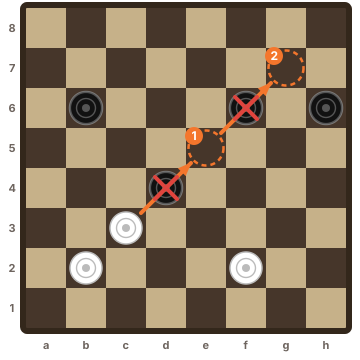
Most of the game’s tactics come out of that one rule. Because your opponent has to capture, you can hand them a piece on purpose and dictate where their man ends up. Give up one, take two or three back on the rebound. Checkers players call these shots, and nearly every tactic in the game is built from them. It also makes checkers unforgiving in a way chess isn’t. A loose move in chess usually costs you a little position. A loose move in checkers can be punished on the spot, because your opponent’s reply is forced and so is yours.
Running out of moves
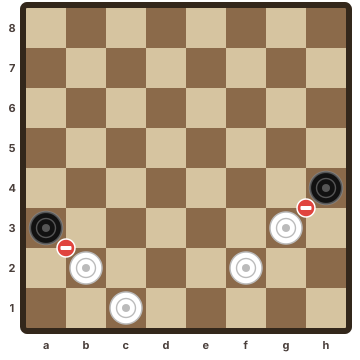
In chess, if it’s your turn and you have no legal move but your king isn’t in check, that’s stalemate and the game is a draw. It’s a well-known escape route for the losing side.
In checkers the same situation is a loss. You don’t have to capture every enemy piece to win. You only have to leave them with nothing they can legally play. A lot of won checkers games end with pieces still on the board and one side simply frozen.
Kings and queens
Both games reward a piece for crossing the board. A chess pawn that reaches the last rank turns into any piece you like, almost always a queen. A checkers man that reaches the far row is crowned a king, and the only thing it gains is the right to move and capture backward. It still goes one square at a time. (In American checkers, a man that jumps into the back row stops there. The crowning ends the turn even if another jump is on offer.)
Which is harder, chess or checkers?
Chess is harder to learn, and measured by sheer size it is far bigger. Checkers is harder to play well than its reputation suggests.
The team that solved checkers counted roughly 500 billion billion possible positions, written 5 × 10²⁰. The same paper puts chess “somewhere in the 1040 to 1050 range” and notes that checkers has about the square root of the number of positions chess has. For a feel of the gap at move one: Black has 7 possible opening moves in checkers. White has 20 in chess, and the tree widens much faster from there. Claude Shannon’s famous 1950 estimate of the number of possible chess games was at least 10120.
None of that makes checkers easy. Work on solving it started in 1989. It ran almost continuously for 18 years, with more than 200 processors on the job at its peak in 1992, and finished in 2007. The authors called it “the most challenging popular game to be solved to date”. That is a strange thing to be true of a children’s game.
Then there is Marion Tinsley. The same paper calls him the greatest checkers player who ever lived and records that he lost only three games between 1950 and 1991. A game with nothing in it doesn’t produce a record like that, because nobody can be that much better than everyone else at tic-tac-toe.
Our own view, from building the AI for this site: beginners don’t lose at checkers because the game is shallow. They lose because forced capture lets a better player steer them. If you want to feel that for yourself, the strategy lessons cover exactly those forcing ideas.
Has either game been solved?
Checkers has. In 2007 Jonathan Schaeffer’s team at the University of Alberta, building on their program Chinook, published a proof in Science that if neither side makes a mistake, the game is a draw. Strong players had suspected as much for decades.
The proof is what’s called a weak solution: it shows the result from the starting position and a strategy that never loses, without working out every one of those 5 × 10²⁰ positions. It also covers only the 8×8 American and English game. International draughts on its 10×10 board, Russian, Brazilian and the rest remain unsolved. We explain what that proof does and doesn’t mean in our guide to whether checkers is solved.
Chess has not been solved and won’t be soon. Schaeffer’s own conclusion was that “chess will remain unsolved for a long time, barring the invention of new technology”. Chess programs such as Deep Blue have beaten the strongest human players, but playing better than any person is a much lower bar than playing perfectly.
A solved game is still worth playing. The proof lives in a database. No human can memorize it, and at the board you still have to find the moves yourself. Our Hard AI searches up to six moves ahead (three for each side) and it’s nowhere near perfect either.
Which came first?
It depends what you count.
Chess has the cleaner paper trail. It’s usually traced back nearly 1,500 years to a game called chaturanga in India. From there it passed through Persia and the Arab world and reached Europe through Spain and Italy. The queen and bishop got their modern, long-range moves in Spain between about 1475 and 1500, which is when chess became recognizably today’s game.
Checkers as a game on the chessboard is younger than that. The European family is generally dated to around the 12th century, in France or Spain, when someone put a jumping game onto the 64-square board that chess players already owned. So in the narrow sense, chess came first, and checkers borrowed its board.
The jumping idea itself is older than that board. Alquerque, the likely ancestor, was played on a grid of lines, and an Arabic text mentions it around 950 AD. Popular accounts push it back as far as 1400 BC in Egypt, but that early evidence is disputed. So chess is the older game on the documented record, and checkers is older only if you accept the disputed early dates for its ancestors. We cover that story, and its many uncertainties, in the origins of draughts and the history of checkers. The first official English rules came from William Payne in 1756.
Are chess and checkers boards the same?
Yes, close enough that you can play either game on either board. Both use an 8×8 grid of alternating light and dark squares, and both are set up the same way round: chess puts a light square in each player’s near-right corner, which is the same thing as the checkers rule of a dark square in the near-left corner.
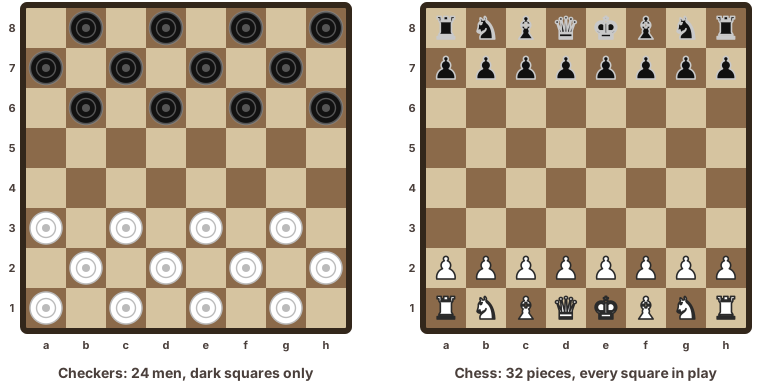
The difference is in how the board gets used. Chess uses all 64 squares. Checkers is played only on the 32 dark ones, so half the board is just spacing. Colors differ by tradition too. Official tournament checkers boards are green and buff, and the pieces are red and white even though the rules call them Black and White.
Can you play checkers on a chess board?
You can. Put twelve men on the dark squares of your three nearest rows, check there’s a dark square in your near-left corner, and you’re set. If you’re short of checkers, coins or bottle caps in two colors work fine. The reverse works too: a checkers board is a perfectly good chessboard.
(This only holds for the 8×8 games. International draughts needs a 10×10 board with 20 men a side, and Canadian checkers needs 12×12.)
What does “playing chess, not checkers” mean?
It’s a saying about strategy and has nothing to do with the rules of either game. Someone “playing chess while everyone else plays checkers” is thinking several steps ahead while the others react to what’s in front of them. Chess stands for strategy, checkers for the obvious move.
The idiom works, but it’s unfair to checkers. The game in that saying took computers 18 years to finish, and tournament checkers has its own opening system, the three-move restriction, just as chess has its opening theory. If anything, forced capture means a checkers player has to look further ahead, because a mistake can’t be quietly walked back.
One family, not one game
One more thing counts in checkers’ favor. “Chess” is, for most people, a single game with a single rulebook. “Checkers” is a family. On this site alone there are 14 versions, and they differ in ways that matter: kings that fly the whole length of a diagonal, men that capture backward, rules that force you to take the largest capture available, boards of 100 and 144 squares. Turkish checkers doesn’t even move diagonally. Its pieces go straight ahead and sideways and use every square on the board.
Whether checkers is simpler than chess depends a lot on which checkers you mean.
So which should you play?
Play checkers if you want a game you can teach a child tonight that still has real depth behind it. Play chess if you enjoy learning a larger rulebook and want the variety six piece types bring. They train different habits. Checkers teaches you to calculate forced sequences exactly. Chess teaches you to coordinate pieces that do different jobs.
Better still, play both. You can play checkers here against the computer or a real opponent, free and without an account. For chess with a friend, 2-player-chess.com does the same job for the other game: share a link and play online, or pass one device back and forth.
Sources:
- Schaeffer, J. et al., “Checkers Is Solved”, Science 317 (2007), pp. 1518-1522: position counts for both games, the 1989-2007 computation, the draw result, the Tinsley record
- Wikipedia: Shannon number
- Wikipedia: History of chess
- Wikipedia: Rules of chess (FIDE Laws of Chess)
- BoardGameGeek: Checkers: dating of the European draughts family, tournament board colors