Checkers King Rules: How Kings Move, Jump and Get Crowned
In checkers, a king is a man that reached the far side of the board and was crowned. It moves and jumps diagonally one square at a time, like a man, but it can go backward as well as forward. That’s the whole difference. Kings don’t fly across the board in American checkers, and they can be captured like any other piece.
That’s the short version. A few details catch people out. A man that reaches the far row in the middle of a jump stops there. Other versions of the game let kings slide the whole length of a diagonal. And an endgame with two kings against one plays out very differently from one king against one.
How do you get a king in checkers?
Move a man onto the last row on your opponent’s side of the board, their back row. It’s crowned as soon as it lands there, and from then on it’s a king.
It doesn’t matter whether the man gets there with a plain one-square move or at the end of a jump. Either way it crowns, automatically.
Nobody starts with a king. The board setup gives each player 12 men and nothing else, so every king in a game is earned. That’s why good players guard their back row for so long. As long as those squares are covered, nobody crowns.
How does a king move in checkers?
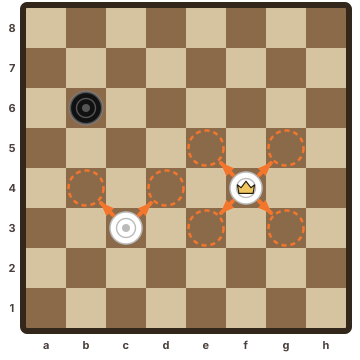
A king moves one square diagonally in any of the four directions: forward left, forward right, back left or back right. It stays on the dark squares, the same as every other piece.
A man only has the two forward directions. That’s the only thing crowning adds, but it changes how the piece plays. A man that walks up the board can never come back. A king can retreat, then come back to defend or attack.
How many spaces can a king move in checkers?
One. In American checkers (English draughts in Britain), a king moves a single square per turn unless it’s jumping. Our engine calls this a “short” king, and it’s the setting our American checkers rules describe.
If you’ve seen a king zip from one corner to the other, you were watching a different game. Russian, International, Pool and most other draughts games use a “flying” king that slides any distance along an open diagonal. More on those below.
Can a king jump backward in checkers?
Yes. A king jumps the same way a man does: over an enemy piece right next to it, onto the empty square just beyond. The difference is direction. A king can jump in all four diagonal directions, so it can capture pieces behind it.
Men can’t do that in American checkers. A man only jumps forward, which is why a king behind the enemy’s lines is so dangerous.
Jumping is compulsory for kings too. If your king (or any of your pieces) can capture, you have to capture. When several captures are available, you can pick any of them. It doesn’t have to be the longest one. Our checkers jumping rules cover forced jumps in more detail.
Can a king jump more than one piece?
Yes, in one turn, through a chain of single jumps. After each jump, if the king can jump again from its new square, it must keep going until no more jumps are left. It can change direction between jumps, so a chain can zigzag forward and back.
What it can’t do is jump two pieces in one leap. Every single jump goes over exactly one piece onto the empty square right behind it. Two enemy pieces side by side on a diagonal can’t be jumped from that direction, because there’s no empty square between them to land on.
Does crowning end your turn in checkers?
Yes. If a man reaches the far row by jumping, it’s crowned and the turn is over. That holds even when the new king could jump again from where it landed. It has to wait for your next turn.
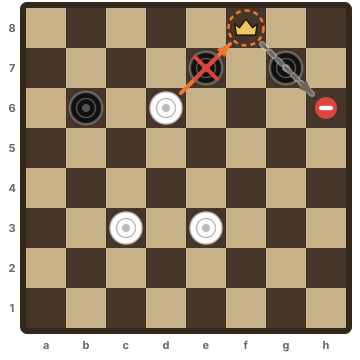
The variants disagree about this rule more than any other, so if you learned “checkers” somewhere else, you may have learned it differently. The table further down shows who does what.
Can you jump a king in checkers?
Yes. A king can be jumped and captured exactly like a man. A plain man can take a king, and so can another king. Being crowned makes a piece stronger, not safe.
A king that wanders off on its own can be forced into a spot where it has to jump into a trap, since capturing is compulsory. It’s the same kind of shot that catches men.
There’s one exception, and it isn’t American checkers. In Italian checkers, a man is never allowed to capture a king. Only a king can take a king there.
How many kings can you have in checkers?
There’s no limit. Every man that reaches the far row gets crowned. Each player starts with 12 men, so 12 kings is the most anyone could ever have.
Can you keep moving a king back and forth?
You can, but it won’t last forever. Shuffling a king between two squares brings up the draw rules. On this site, a game is drawn if the same position comes up three times with the same player to move. It’s also drawn if 40 moves go by on each side with no capture and no man moved, which is exactly what happens when both players only move kings.
So a king shuffle is a fine way to hold a draw you’re happy with. It’s a bad way to try to win. Our post on what happens when you can’t move in checkers goes through every way a game can end.
Can one king beat another king?
Usually not. We had our engine work out every position with one king each on an American checkers board, 1,984 positions counting whose turn it is. With best play from both sides, 1,308 of them are draws. A king can still lose one-on-one, but only when it’s already badly placed, often stuck on the edge, and the other king can force it into a jump.
Two kings against one is a different story. We ran the same exhaustive search on every position with two kings against a lone king. With the two kings to move, they win 14,846 of the 14,880 positions. The 34 exceptions are positions where the lone king is already close enough to win one of the pair back, or where the pair is jammed in a corner. The longest win took 17 moves by the side with two kings, starting from kings on b8 and d8 against a lone king on c5.
That’s well inside the 40-move draw limit, so the extra king wins. You do need the method, though, because the lone king heads for the double corner and you have to drive it out. Our lesson on winning endgames with kings shows how. And if you’re stuck on a real position, the checkers solver will find the best move for you.
What is a flying king in checkers?
A flying king moves any number of empty squares along a diagonal. It also captures from a distance. It can jump an enemy piece several squares away, as long as the squares in between are empty, and land on any empty square beyond it.
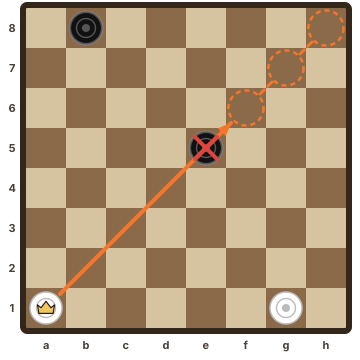
Flying kings are the norm. Twelve of the 14 draughts games on this site use them, including Russian checkers and International draughts. The rule matters most in the endgame, where one flying king can cover a whole diagonal on its own.
How do king rules differ in other checkers variants?
The two rules that change most are how far a king moves and what happens when a man reaches the far row in the middle of a capture. We read every cell below from the rule settings our engine uses to play each game.
| Game | King moves | Man reaches far row mid-capture | Men capture backward | Men can capture kings |
|---|---|---|---|---|
| American checkers | One square, diagonal | Crowns, turn ends | No | Yes |
| International draughts | Any distance, diagonal | Keeps jumping as a man; crowns only if the capture ends on the far row | Yes | Yes |
| Russian checkers | Any distance, diagonal | Crowns at once and keeps jumping as a king | Yes | Yes |
| Pool checkers | Any distance, diagonal | Keeps jumping as a man; crowns only if the capture ends on the far row | Yes | Yes |
| Spanish checkers | Any distance, diagonal | Crowns, turn ends | No | Yes |
| Italian checkers | One square, diagonal | Crowns, turn ends | No | No |
| Turkish checkers | Any distance, along rows and columns | Keeps jumping as a man; crowns only if the capture ends on the far row | No (men capture forward and sideways) | Yes |
Russian’s rule is the most dramatic. A man that touches the far row mid-jump turns into a king on the spot and finishes the same capture with king powers. That’s the game’s signature rule.
Turkish is the odd one out in another way. It’s played on every square of the board, and its pieces move straight rather than diagonally. Its kings slide any distance along rows and columns.
You can try all of them, flying kings included, from the checkers variants page. Or stay with the short king and play a game of checkers now.