Checkers Jumping Rules: Forced Jumps, Double Jumps and More
In checkers, a jump is how you capture. Your piece hops diagonally over an enemy piece next to it and lands on the empty square just beyond, and the jumped piece comes off the board. Jumping is compulsory: if you can jump, you must. And if the landing square offers another jump, the same piece keeps going in the same turn.
That’s the core of the checkers jumping rules. The arguments start over the details, which are below, one question at a time. The answers are for American checkers (English draughts), exactly as our own engine plays it. A table near the end shows where other variants break from it.
Do you have to jump in checkers?
Yes. If any of your pieces can make a jump, you have to make one. You can’t make a quiet move instead, even if the jump walks straight into a trap.
Because captures are forced, you can push your opponent into a jump they’d never choose. You give up one piece, they have to take it, and their capturing piece lands where you can take two back. BoardGameGeek’s family page calls these forced sacrifice combinations “shots”. Take the forced jump away and most checkers tactics go with it.
So can you refuse to jump? Not under the official rules. If you grew up playing with optional jumps, that was a house rule. People search for a checkers game with no forced jump, but ours doesn’t have that setting. It plays the standard rule, so when a jump is on the board, the only moves it offers you are jumps.
What happens if you miss a jump?
In a game played by the rules, you can’t miss one. The jump isn’t a choice, so a move that skips it is illegal.
You may have heard of “huffing”, where your opponent could remove the piece that failed to capture. That’s an old rule, and it’s obsolete in modern play. Today the capture is just compulsory. Our game won’t let a move through that ignores a jump, so the question never comes up.
Can you double jump in checkers?
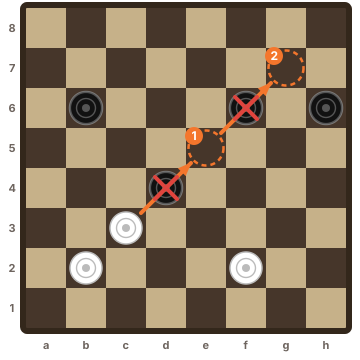
Yes. A double jump is two captures in one turn by the same piece. After the first jump, if another enemy piece sits diagonally next to the landing square with an empty square behind it, you jump again.
Ordinary men can double jump. You don’t need a king.
Do you have to finish a double jump?
Yes. You can’t stop halfway. If a jump lands your piece where it can jump again, it must, and it keeps going until no capture is left. Sultan Ratrout’s guide to draughts variants, hosted by the world draughts federation, puts it this way for American checkers: any sequence may be chosen “as long as all possible captures are made.”
In our game a multi-jump counts as a single move. You tap or drag the piece to its final square, and the game plays every hop on the way.
Can you triple jump in checkers?
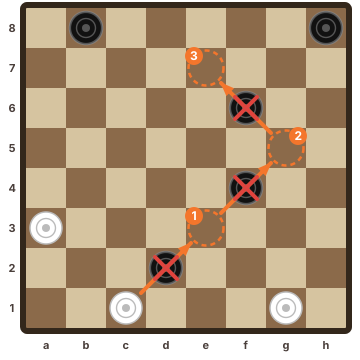
Yes. There’s no limit to the chain. A double, triple or longer jump all follow the same rule, and one piece keeps capturing for as long as a jump is available from where it lands.
Can you change direction during a multi-jump?
Yes. Each jump in the chain can go along either forward diagonal, so a man can zigzag. What it can’t do is jump backward, toward its own side of the board. A king can change direction freely, backward included.
Can you move or jump backwards in checkers?
Not with a man. In American checkers a man moves and jumps only forward, and that holds in the middle of a multi-jump too. If the next capture in a chain lies behind your man, the chain ends.
Kings are different. Once a man is crowned, it moves and jumps diagonally in all four directions, one square at a time. Our checkers king rules post covers kings in full.
Plenty of other variants do let men capture backward. The table further down shows which.
Can you jump sideways in checkers?
No. Every move and every jump in checkers is diagonal, on the dark squares. The one exception on our site is Turkish checkers, which uses all 64 squares and has men that move and jump straight forward or sideways.
Can you jump your own piece in checkers?
No. You can only jump an enemy piece. Your own pieces block you: if one of your men sits diagonally in front of another, the back one can’t hop over it, and nothing is captured.
Two more conditions trip people up:
- The landing square must be empty. If a second piece sits behind the one you want to jump, of either color, that jump isn’t there.
- You can’t jump two pieces in a row. A man jumps one adjacent piece and lands directly behind it. Two enemy pieces in a line, back to back, are safe from that direction.
Can a piece be jumped twice in one move?
No. In a long chain it can look as if your piece could loop back over something it already took. It can’t. Jumped pieces stay on the board until the whole move is finished, and a piece that’s already been jumped can’t be jumped again or passed through.
Our engine works the same way. Captured pieces stay put during the sequence and all come off together at the end.
Can you jump a king in checkers?
Yes. A king can be jumped and captured like any other piece, by a man or by another king. Kings are stronger, but they can still be taken. The king rules post goes further. One variant does protect kings: in Italian checkers, a man may never capture a king.
What if you have more than one jump?
In American checkers, you choose. If two different pieces can jump, or one piece has two routes, you may take any one of them. You don’t have to take the longest one. A single jump is legal even when a triple jump is sitting elsewhere on the board.
Whatever you pick, you must finish it. Choosing the single jump doesn’t let you stop a chain halfway.
International draughts works the other way. There you must take the sequence that captures the most pieces. Brazilian, Spanish and several other variants have the same maximum-capture rule. If you’re used to checkers, it’s the rule most likely to catch you out in International draughts.
If you can’t tell which capture is better, set the position up in our checkers solver and it will show you the best move.
What happens when you reach the king row mid-jump?
The move ends there. In American checkers, when a man lands on the far row during a jump, it’s crowned and the turn stops. That’s true even if the new king could keep jumping backward. It has to wait for your next turn.
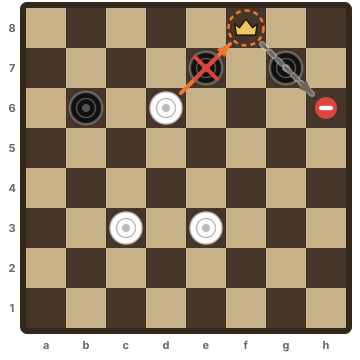
Other variants handle this very differently. We ran this exact position through our engine under several rule sets:
- Russian checkers: the man is crowned on f8 and carries on as a king, capturing g7 in the same move.
- Pool and Brazilian: the man carries on as a man, jumps g7 backward and lands on h6. It isn’t crowned, because the move didn’t end on the far row.
- Spanish: same as American. The move stops on f8 and the man is crowned.
Checkers jumping rules in other variants
Every variant we play on this site forces captures. After that they split. Here’s how the capture rules compare in eight of them. Every cell comes from the settings our engine uses for that game.
| Game | Must capture? | Men capture backward? | Must take the most pieces? | King moves | Man reaches king row mid-jump |
|---|---|---|---|---|---|
| American checkers | Yes | No | No, free choice | One square | Stops and is crowned |
| Pool checkers | Yes | Yes | No, free choice | Any distance | Keeps jumping as a man |
| Russian checkers | Yes | Yes | No, free choice | Any distance | Crowned, keeps jumping as a king |
| Czech checkers | Yes | No | No, but a king must capture if it can | Any distance | Stops and is crowned |
| Spanish checkers | Yes | No | Yes, then the most kings | Any distance | Stops and is crowned |
| Italian checkers | Yes | No | Yes, then further tie-breaks | One square | Stops and is crowned |
| Brazilian draughts | Yes | Yes | Yes | Any distance | Keeps jumping as a man |
| International draughts | Yes | Yes | Yes | Any distance | Keeps jumping as a man |
“Any distance” means a flying king. It slides along an open diagonal like a bishop in chess and can capture a piece from far away. Italian’s extra tie-breaks run in order: capture with a king before a man, then take the most kings, then take a king as early in the chain as possible.
The checkers variants guide covers each game in full.
House rules you might have learned
A lot of confusion comes from rules people learned at home. Ratrout’s guide lists two common ones for American checkers that player associations don’t recognize. In one, capturing with a king comes before capturing with a man. In the other, a man crowned during a jump can carry on capturing in the same move. Neither is part of the official game. (Both are real rules in other variants, though: the first is Czech, the second is Russian.)
Optional jumps and jumping your own men are house rules too. If you learned any of them, the official game will feel stricter at first, and a lot more tactical.
Play by the real rules
The quickest way to learn these rules is to play a few games where they’re enforced for you. Our checkers game is free, with no signup, and only ever offers you legal moves, so forced jumps and multi-jumps happen exactly as described here. The full rulebook is on our American checkers rules page. If a game ever stalls with no legal move, see what happens when you can’t move in checkers.
Sources:
- Sultan Ratrout, A Guide to Checkers Families and Rules (2018), p. 18: American checkers capture and crowning rules, and the two house-rule variants not recognized by player associations
- BoardGameGeek: Checkers family wiki: compulsory capture across the family and the “shots” it produces
- Rules for every variant in the table: the settings in this site’s game engine, which follow the sources listed on each variant’s rules page