Stalemate in Checkers: What Happens When You Can't Move?
There is no stalemate in checkers. If it’s your turn and none of your pieces can make a legal move, you lose the game. It doesn’t matter how many pieces you still have. Being blocked counts the same as having every piece captured.
That’s the opposite of chess, where having no legal move is usually a draw. Checkers does have draws, but they come from other rules: a position repeated three times, a long stretch with no progress, or both players agreeing to stop.
What happens if you can’t move in checkers?
You lose. The rule is the same one that makes capturing everything a win. A player wins when the opponent has no legal move on their turn, and there are two ways to get there: capture all of their pieces, or block the ones they have left.
Sultan Ratrout’s guide to draughts variants, hosted by the world draughts federation, gives the general rule for the whole family. A player wins if the opponent has no legal move, because all his pieces are captured or he is completely blocked (or he resigns). BoardGameGeek’s entry for American checkers says the same: you win by capturing all your opponent’s pieces or blocking all their moves.
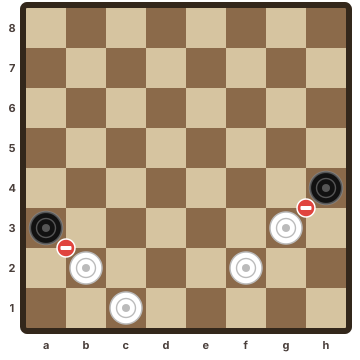
Black has two men and White has four, so on material alone this doesn’t look finished. But Black can’t step and can’t jump, so the game is over and White wins. We checked this position against the engine that runs this site. Black has zero legal moves, and the result is the same in all ten of our 8×8 diagonal games, from pool checkers to Russian checkers.
Remember that jumping is compulsory. A man that can’t step forward might still have a capture, and if it does, that capture is your move. You’re only blocked when there is no step and no jump anywhere on the board. (Our post on checkers jumping rules covers when you have to take.)
What if neither player can move?
Then whoever has the turn loses. Only the player to move needs a legal move, so if both sides are jammed, the other player’s frozen pieces never come into it.
Is there a stalemate rule in checkers?
Not in the chess sense. “Stalemate” is a chess word. In chess, the player to move who isn’t in check and has no legal move is stalemated, and the game is a draw. The rules of chess also have a fifty-move rule and threefold repetition.
Checkers never adopted the stalemate draw. When people say a checkers game “ended in stalemate”, they usually mean one of two things. Either one side was blocked, which is a loss for that side, or neither player could make progress and the game was drawn. Those are separate rules with opposite results.
For a side-by-side of the two games, see checkers vs chess.
Can checkers end in a draw?
Yes. A game of checkers can end in a tie, and at the top level it often should. In 2007 Jonathan Schaeffer’s team at the University of Alberta proved that perfect play by both sides leads to a draw. We explain what that proof covers in is checkers solved?
On this site an American checkers game is drawn in any of these cases:
- Threefold repetition: the same position appears three times with the same player to move. Same pieces, same squares, same kings. The starting position counts as the first time.
- No progress for 40 moves each: 40 moves by each side pass (80 moves in total) with no capture and no man moved. In practice that means only kings have been shuffling around.
- Agreement: in online games you can offer a draw, and the game ends as a draw if your opponent accepts.
The 40-move count is our site’s rule. The research we build from records “no-progress conventions” for American checkers rather than a single agreed number, and other checkers sites quote both 40 and 50. If you play in a club, ask which count they use.
Two things are missing from that list. One king against one king isn’t an instant draw here; that game runs until it repeats or hits the 40-move limit. And in games against the computer, or against a friend on the same device, there’s no draw offer or resign button. Those games only end on the board.
How can a game of checkers end?
A game ends when one side wins on the board or a draw rule kicks in. Online games add a few endings that have nothing to do with the position: a draw by agreement, resigning, and running out of time.
Here’s every ending for an American checkers game on this site.
| How it ends | Result | When |
|---|---|---|
| All of a player’s pieces are captured | Loss for that player | Any game |
| A player has pieces but no legal move on their turn | Loss for that player | Any game |
| Same position three times, same player to move | Draw | Any game |
| 40 moves each with no capture and no man moved | Draw | Any game |
| Draw offered and accepted | Draw | Online only |
| A player resigns | Loss for that player | Online only |
| A player runs out of time on 4 turns (60 seconds each) | Loss on time | Online only |
The time rule is gentle. The first 3 times your 60 seconds run out, the server plays a move for you and the game goes on. The fourth time, you lose. Our ratings page has the details.
If you want the moves and rules in one place, the American checkers rules page covers winning and draws alongside everything else. For the full picture of how kings move once they’re crowned, read our checkers king rules.
Do other checkers variants have the same draw rules?
The no-move rule doesn’t change. In every one of the 14 draughts variants on this site, a player with no legal move on their turn loses. The draw rules are where the games split apart.
This table shows how each game ends here, taken straight from the settings our engine plays with.
| Game | Can’t move | Repetition | No-progress draw | Endgame move limit | Other draw |
|---|---|---|---|---|---|
| American checkers | Loss | 3 times | 40 moves each | None | None |
| Pool checkers | Loss | 3 times | 40 moves each | 3 kings v 1 king: win in 13 moves each | None |
| Russian checkers | Loss | 3 times | 40 moves each | 3 kings v 1 king: win in 15 moves each | None |
| Portuguese checkers | Loss | 3 times | 20 moves each | 3 kings v 1 king: win in 12 moves each | None |
| International draughts | Loss | 3 times | 25 moves each | 1 king v 3 pieces: 16 moves each. 1 king v 2 pieces: 5 moves each | None |
| Canadian checkers | Loss | 3 times | 25 moves each | Same as International | None |
| Turkish checkers | Loss | 3 times | 40 moves each | None | One piece each is an instant draw |
In the International and Canadian limits, the side with 2 or 3 pieces must have at least one king. The Pool, Russian and Portuguese limits apply only when all three of the stronger side’s pieces are kings. If the stronger side doesn’t win inside the limit, the game is drawn.
Some of these numbers come from a federation and some are our own. Portugal’s federation sets the 20-move rule and the 12-move limit for three kings against one. International draughts takes its counters from the world federation, and Canadian follows International. The Russian and Pool limits are the codified ones for those games. For the others, where the research we work from lists no fixed number, we use 40 moves each. The one-piece-each draw in Turkish is our house rule too, until we can source the Turkish federation’s rulebook.
Is a blocked player ever not the loser?
Yes, in one game we know of. In Slovak checkers, according to Ratrout’s guide, a player with pieces on the board but no legal move gets a draw, not a loss. We don’t host Slovak checkers, and it’s the only game in our research where being blocked is a draw. Give-away checkers flips the rule the other way: you’re trying to lose your pieces, so the first player left with no legal move wins. You can see the games we do host in the checkers variants guide.
Why blocking matters in real games
Because blocking wins, you don’t have to hunt down every last piece. Late in a game, a player with a king or two more can often end it faster by taking away the last few squares than by chasing men around the board.
It works the other way too. If you’re behind, keep an eye on your own mobility. A side with only a couple of men stuck on the edge can run out of moves while it still looks alive.
You can try it now. Play checkers against the computer and see how often a game ends with pieces still on the board.
Sources:
- Sultan Ratrout, A Guide to Checkers Families and Rules (2018), p. 3: a player wins when the opponent has no legal move (all pieces captured, completely blocked, or resigned); draws by agreement. p. 16: Portuguese 3 kings v 1 king rule. p. 17: Slovak checkers, no legal move with pieces left is a draw. p. 21: in give-away checkers the first player with no legal move wins
- BoardGameGeek: American Checkers / English Draughts: win by capturing all pieces or blocking all moves. International Checkers: draw conditions
- Schaeffer, J. et al., “Checkers Is Solved”, Science 317 (2007): perfect play by both sides leads to a draw
- Wikipedia: Rules of chess, citing the FIDE Laws of Chess: stalemate, the fifty-move rule and threefold repetition