Abstract Strategy Games: What They Are, and the Classics to Play Online
Abstract strategy games are board games where nothing is hidden, nothing is left to chance, and the theme barely matters. Both players see the whole board. There are no dice and no cards to draw. The better sequence of moves wins. Checkers, chess and Go are the standard examples.
We run a checkers site, so checkers is our home game and the yardstick for everything below. Each classic abstract strategy game you can play online free gets compared to it: the board, how the pieces move and capture, and how you win.
What are abstract strategy games?
Abstract strategy games are strategy games with little or no theme, little or no randomness, and little or no hidden information. You can see everything your opponent can see, and the result depends on the choices the two of you make, not on a dice roll or a lucky draw.
“Abstract” here means the game isn’t pretending to be about anything. A piece may be called a king, a stone or a pawn, but nothing is being simulated. Wikipedia’s article on the category puts the test neatly: the game “would function identically if the pieces were replaced with simple geometric shapes.”
Most definitions share a few more traits. Players take turns, one move at a time, and every legal move is spelled out by the rules. The play is spatial: you’re reading patterns on a grid and planning ahead. And skill shows. A player who can see a few moves further will almost always beat a beginner. That’s very different from a card game, where a weak player with a good hand can win the night.
The exact definition is often debated.
Perfect information, no luck
Two terms come up in every definition.
Perfect information means every player can see the whole state of the game at all times. Chess is the textbook example. Poker is the opposite, because you can’t see your opponents’ cards. Checkers, Go, Reversi and shogi are all perfect-information games.
No luck means no dice, no shuffled deck and no random events. Two players who make the same moves get the same game every time.
A game with both traits and no real theme is sometimes called a “pure” abstract. Go and checkers fit that strictly. Chess is an abstract too, but its pieces carry a light, stylized theme, so it isn’t always counted as pure. Stratego sits on the border: no luck, but your opponent’s pieces are hidden from you.
Is backgammon an abstract strategy game?
Opinions differ. Backgammon hides nothing, so in one sense everything is on the board. But the dice decide which moves you’re allowed to make, and that luck is why it isn’t a pure abstract strategy game. Some game scholars still count it, and others leave it out.
The classic abstract strategy games, compared with checkers
These are the old games people still play everywhere. Here’s the short version.
| Board | Start | How you capture | How you win | |
|---|---|---|---|---|
| Checkers | 8×8, dark squares only | 12 men each, fixed setup | Jump over the piece. Forced | Take every piece, or leave the other side no legal move |
| Chess | 8×8, all 64 squares | 16 pieces of six types | Move onto the piece’s square. Optional | Checkmate the king |
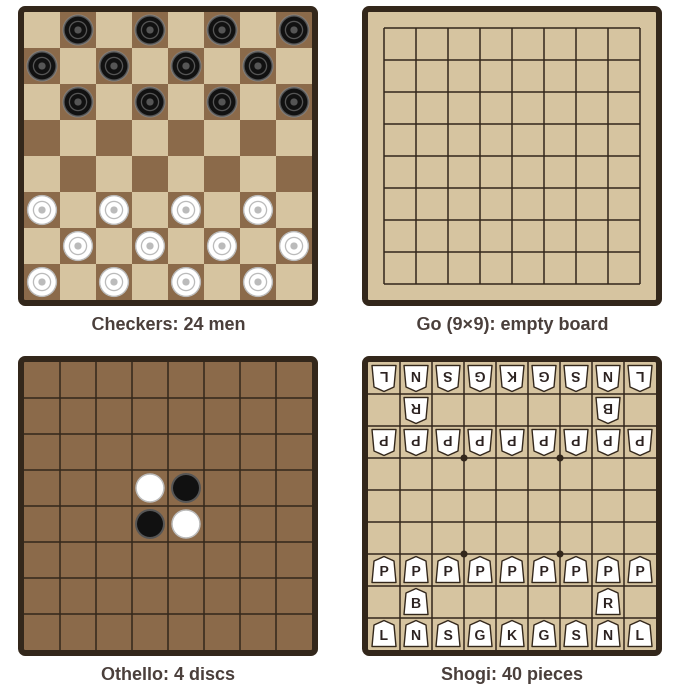
| Go | 19×19 lines (9×9 and 13×13 for learning) | Empty board | Surround a stone or group | More territory at the end |
| Reversi / Othello | 8×8, all 64 squares | Four discs in the centre (Othello) | Trap a line of discs, which flip to your colour | More discs when the board fills |
| Shogi | 9×9, 81 squares | 20 pieces each | Move onto the piece’s square, then drop it back in as yours | Checkmate the king |
Checkers
Checkers is about as pure as an abstract gets. Each side has 12 identical men on the dark squares of an 8×8 board. They move one square diagonally forward, capture by jumping, and must capture whenever they can. A man that reaches the far row becomes a king and can move backward. You win by taking every enemy piece or by leaving your opponent with no legal move. You can learn the full rules in a few minutes.
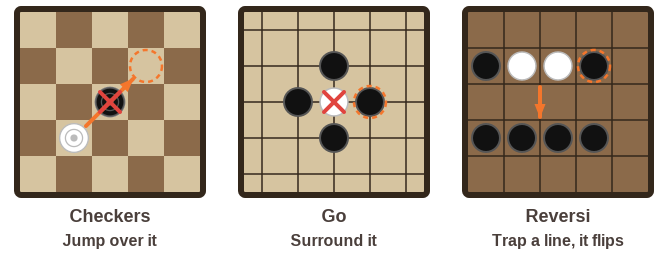
The forced capture is the rule to watch. It turns checkers into a game of traps: you give up a piece on purpose so that your opponent has to take it, and their forced jump puts them where you want them. Most of the other classics below give you a choice about capturing. Checkers doesn’t.
Checkers is also a family. Our variants guide covers 14 versions, from International draughts on a 10×10 board to Turkish checkers, where pieces move straight instead of diagonally.
Chess
Chess uses the same board as checkers, and that’s most of what they share. Each side starts with 16 pieces of six types, each with its own move. You capture by landing on an enemy piece, and you never have to. You win by checkmating the king, and if a player has no legal move but isn’t in check, the game is a draw. In checkers that same situation is a loss.
Chess has a light theme (kings, queens, knights), but nothing in the rules depends on it. We go through every rule difference, and which game is harder, in chess vs checkers.
Go
Go is the oldest of the group. It was invented in China more than 2,500 years ago and is believed to be the oldest board game still played without a break. It’s called weiqi in China, baduk in Korea and igo in Japan.
Almost everything about Go runs opposite to checkers. The board starts empty. You place stones on the points where the lines cross, and once a stone is down it never moves. Nothing jumps. A stone or a connected group is captured when the other player’s stones surround it on every side along the lines, and captured stones come off the board. You win by fencing off more territory than your opponent, with captures and a few compensation points for White counted in.
The full board is 19×19, with 361 points. Beginners usually start on 9×9 or 13×13. Go also held out against computers for a long time. Before 2015 the best Go programs played only at amateur level. Then in October 2015 Google DeepMind’s AlphaGo beat the European champion Fan Hui five games to nil on a full board.
If you want to try it, play-go-online.com lets you start on the 9×9 board against the computer on three difficulty levels. You can also send a friend a link, or use quick match to find another player. There’s no account to make.
Reversi and Othello
Reversi is played on the same 8×8 grid as checkers, but on all 64 squares and with no checkered pattern. Both players share 64 identical discs, dark on one side and light on the other. On your turn you place a disc so that a straight line of your opponent’s discs sits between it and another of yours. Every disc in that line flips to your colour. When the board fills up, whoever has more discs showing wins.
The contrast with checkers is sharp. Nothing ever leaves the board in Reversi, and a disc can change sides many times. A move is legal only if it flips at least one disc, and if you have no legal move you pass. In checkers, having no move loses the game.
Reversi dates from 1883, when two Englishmen each claimed to have invented it. Othello is the version patented in Japan in 1971 by Goro Hasegawa, with a fixed setup of four discs in the centre, and it’s the rule set used in tournaments today. You can take on the computer at four levels at reversiboardgame.com, with unlimited undo, or pass one device back and forth with a friend.
Shogi
Shogi is Japan’s member of the chess family. The board is 9×9, each side has 20 pieces, and you win by checkmating the king. Most pieces can promote when they move into the last three rows, the opponent’s starting zone, which is a wider target than the single back row a checkers man needs.
The rule that sets shogi apart is the drop. A piece you capture isn’t gone. It goes into your hand, and on a later turn you can put it back on the board as one of your own. Shogi was the first chess-like game to allow this. In checkers a captured man is removed for good. In shogi the army you lose can come back at you.
If you already play chess, shogiboardgame.com has a side-by-side of shogi and chess that maps what carries over and what doesn’t. The same site lets you play the computer free with hints and rules coaching, or pass and play with a friend.
Chinese checkers
Chinese checkers is an abstract too, and neither Chinese nor a form of checkers. It began in Germany as Sternhalma. Nothing gets captured: you race your pieces across a star-shaped board by hopping over others. Its odd name has its own story, and you can play Chinese checkers here.
Modern abstract strategy games
The classics aren’t the whole category. Designers kept inventing new abstract board games through the 20th century and into the 21st.
A few you’ll see named again and again:
- Abalone (1987).
- The GIPF series by Kris Burm, starting with GIPF in 1996 and including DVONN (2001) and TZAAR (2007).
- Hive (2001), played with hexagonal tiles and no board at all.
- Santorini (2004).
- Blokus, Quoridor and Onitama.
Some, like Hive, carry a light theme, the way chess does. Most share the classics’ principles: little or nothing hidden, and little or no luck. If you enjoy the modern titles, the old games will feel familiar.
What board games are like checkers?
It depends what you like about checkers.
- Same grid, different game: Reversi. It’s an 8×8 grid, but you flip pieces instead of capturing them.
- Same board, more piece types: chess. It has the same board and a fixed starting setup, with six kinds of piece instead of one.
- Captures and promotion, with a twist: shogi. Captured pieces come back into play on your side.
- Something completely different: Go. An empty board, no moving pieces, and territory instead of captures.
- More checkers: the variants. International draughts on 10×10, with flying kings and men that capture backward, plays very differently from the American game.
Have any abstract strategy games been solved?
American checkers has. In 2007 Jonathan Schaeffer’s team at the University of Alberta published a proof that if neither side makes a mistake, the game is a draw. It took computers 18 years, and the proof covers only the 8×8 American and English game. The other draughts variants are unsolved. We explain what that proof covers in our guide to whether checkers is solved.
Othello followed. A 2023 computer analysis found that perfect play on the 8×8 board also ends in a draw. Chess remains unsolved, and the team that solved checkers expected it to stay that way “for a long time, barring the invention of new technology.”
Solved doesn’t mean dead. The answers sit in databases nobody can memorize, so at the board you still have to find the moves yourself.
Where to play abstract strategy games online
These sites let you play the classics free in a browser:
- Checkers: play here against the computer at four levels, with a friend on one device, or online against real players. No account needed.
- Go: play-go-online.com, against the computer or a friend.
- Reversi and Othello: reversiboardgame.com, against the computer or a friend on the same device.
- Shogi: shogiboardgame.com, against the computer or a friend on the same device.
If you’re new to all of them, start with checkers. You can learn the rules over a cup of coffee, and the strategy lessons show how much depth those few rules hide.
Sources:
- Wikipedia: Abstract strategy game: definition, pure and themed abstracts, backgammon, modern titles and dates
- Wikipedia: Perfect information
- Wikipedia: Go (game): rules, board sizes, origins, AlphaGo
- Wikipedia: Reversi: rules, 1883 and 1971 dates, the 2023 analysis
- Wikipedia: Shogi: board, pieces, drops, promotion zone
- Schaeffer, J. et al., “Checkers Is Solved”, Science 317 (2007), pp. 1518-1522